Our Top Picks
Jasper AI
Enterprise-grade AI writing assistant for marketing teams
Starting at $49/mo · Best for: Marketing teams, Agencies
Visit Jasper AICopy.ai
AI-powered copywriting for marketing and sales teams
Starting at $29/mo · Best for: Sales teams, Marketers
Visit Copy.aiFrase.io
AI search optimization with GEO scoring, content briefs, and AI Visibility tracking
Starting at $49/mo · Best for: SEO professionals, Content agencies
Try Frase FreeWritesonic
AI writing and image generation for content creators
Starting at $16/mo · Best for: Content creators, Small businesses
Try Writesonic FreeHealthcare content is not like other content. A wrong word in a blog post about sneakers is embarrassing. A wrong word in a blog post about medication dosages is dangerous. If you’re a healthcare marketer considering AI writing tools (also called AI medical writing platforms, AI healthcare content tools, or AI clinical content generators), you need to understand that distinction before you generate a single paragraph.
The good news: several AI writing tools have matured to the point where they can genuinely help healthcare marketing teams produce more content, faster, without sacrificing accuracy. The bad news: none of them can replace clinical review. Not one. Not even close.
We tested four leading AI writing tools on real healthcare marketing tasks: hospital service line pages, patient education content, health tech product descriptions, and blog posts targeting competitive medical keywords. Here’s what actually works.
What Is the Best AI Content Tool for Healthcare Marketers?
Jasper AI is the best overall AI content tool for healthcare marketers, thanks to its brand voice training and Knowledge base that lets you upload approved medical terminology and compliance guidelines. For healthcare teams that need to optimize for both Google search and AI answer engines (ChatGPT, Perplexity, Claude, Gemini), Frase.io at $49/mo Starter is the best-in-class research and brief generator with explicit AI search features (GEO score, AI Visibility tracking). For a direct head-to-head look at the top two SEO picks, see our Frase vs Surfer SEO comparison.
What’s New in AI Healthcare Content Tools (2026)
Three platform changes between late 2025 and early 2026 changed the buying decision for healthcare marketers:
- Frase repositioned around AI search optimization. The new Starter plan ($49/mo) bundles a GEO score and AI Visibility tracking that monitors whether ChatGPT, Perplexity, Claude, and Gemini cite your healthcare content. For patient education content (where AI engines increasingly answer health questions before users click through to clinic sites), this is the most important AEO feature any healthcare-relevant tool added this year.
- Jasper ended its affiliate program (March 2026). The product still works well for healthcare content, but the partner ecosystem around it has thinned. We continue to recommend Jasper for hospital and health-system marketing teams that need brand voice control.
- Copy.ai discontinued its free tier and terminated its affiliate program. Paid plans still start at $29/mo for the Chat plan, but the free tier is gone.
The net effect: Frase is now the strongest pick for SEO-and-AI-search-optimized healthcare content, Jasper remains the strongest for compliance-aware brand voice work, and the budget tier (Writesonic at $13/mo) is unchanged.
Why Healthcare Content Is Different
Before we get into the tools, it’s worth spelling out what makes healthcare content uniquely challenging:
Accuracy is non-negotiable. Google’s Helpful Content system and its Search Quality Rater Guidelines put healthcare firmly in the YMYL (Your Money or Your Life) category. Content that gets medical facts wrong doesn’t just rank poorly, it can harm people. Every claim needs to be verifiable.
E-E-A-T is critical. Experience, Expertise, Authoritativeness, and Trustworthiness matter more in healthcare than in almost any other niche. Google wants to see content backed by credentialed authors and sourced from reputable medical literature. AI-generated healthcare content without human expert review is a liability.
Compliance is always in the room. HIPAA, FDA advertising regulations, FTC guidelines on health claims: healthcare marketers operate inside a web of rules that most content creators never think about. Your AI tool won’t know that a certain phrasing constitutes an unapproved medical claim. You need to.
Patient trust is earned slowly and lost instantly. Your audience is often anxious, searching for answers about their health or a loved one’s health. Tone matters. Clinical jargon alienates. Oversimplification misleads. Getting the balance right is hard even for experienced writers.
How We Tested
We evaluated each tool on five real healthcare marketing tasks:
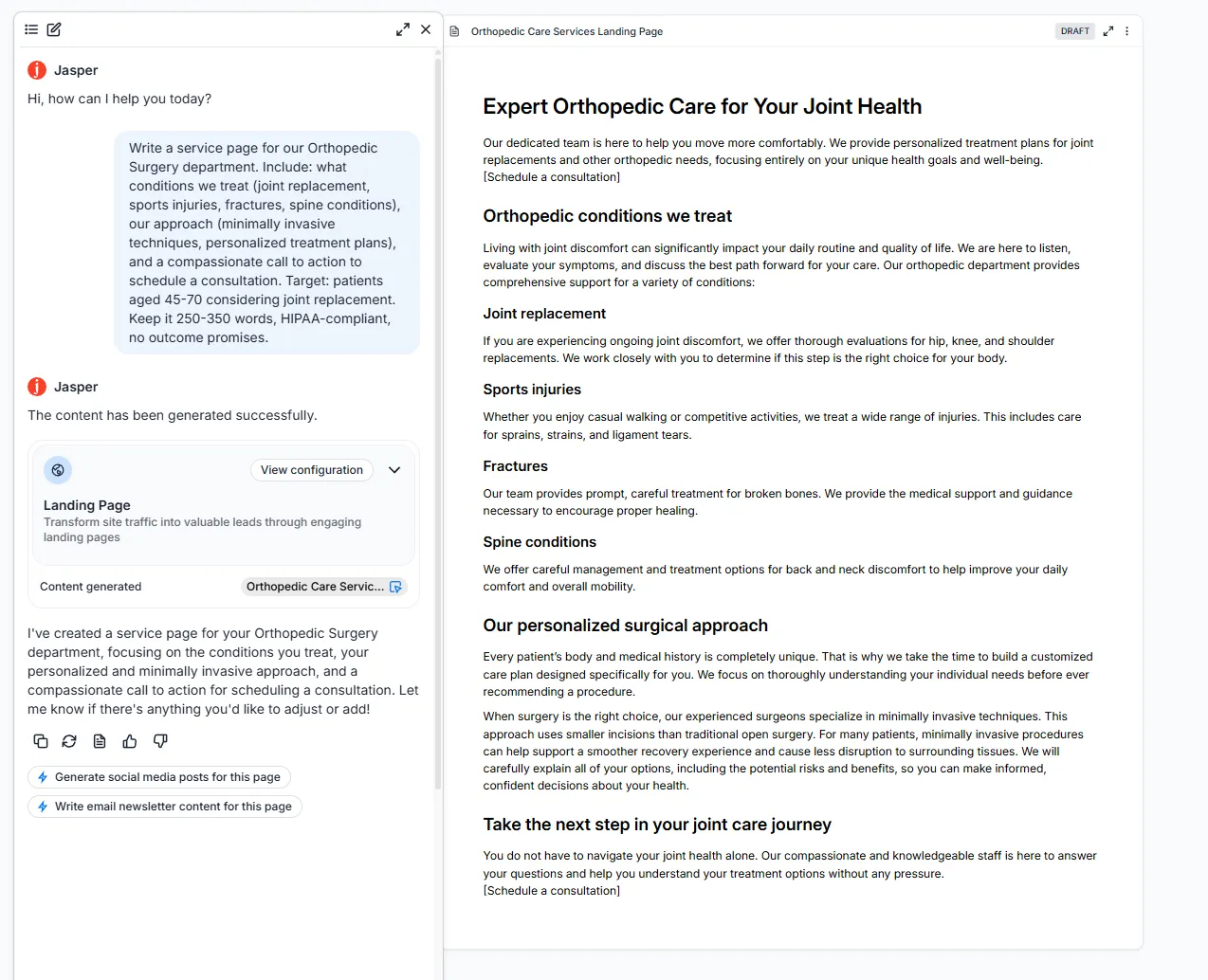
- Hospital service line page (orthopedic surgery department overview)
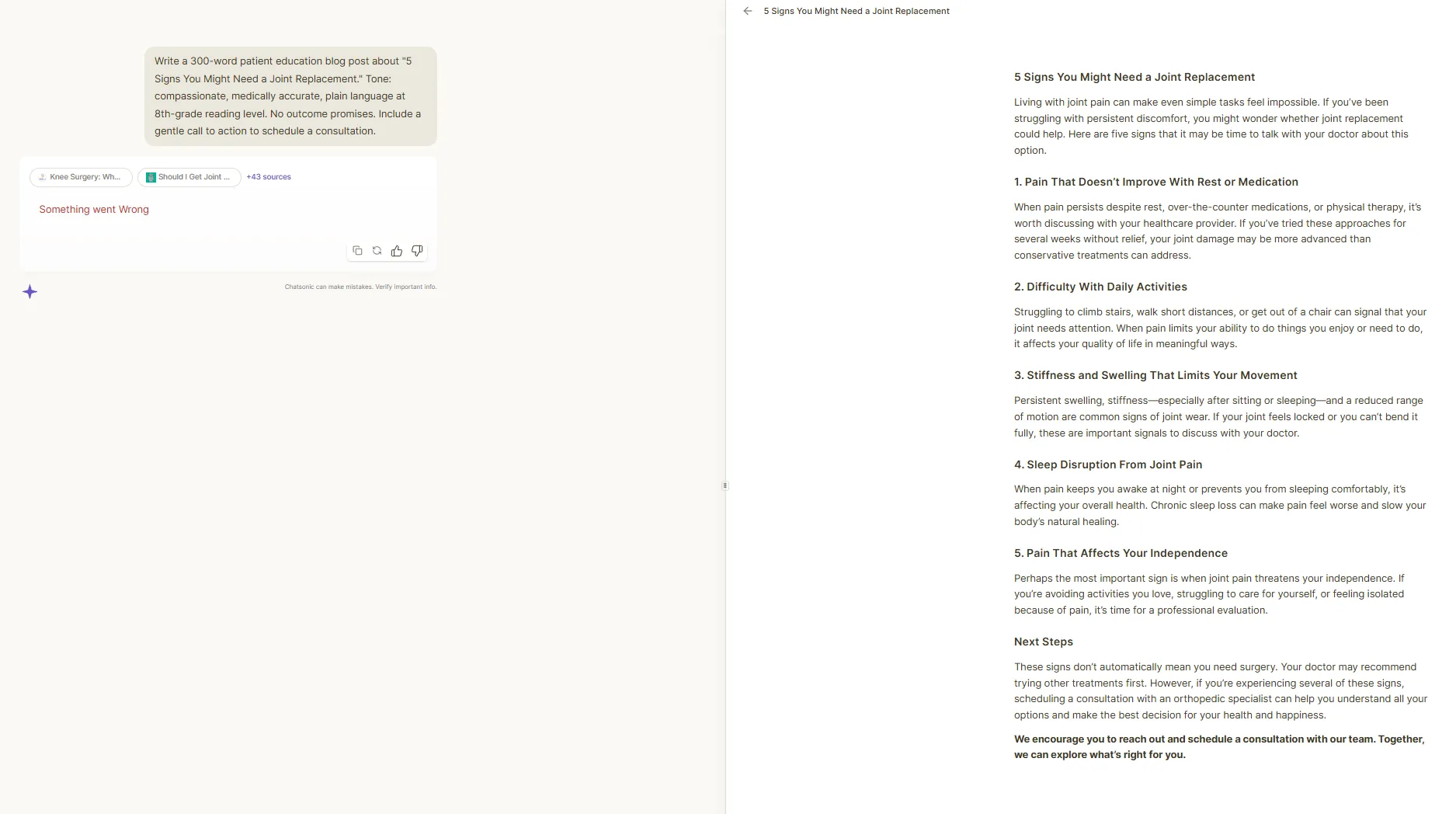
- Patient education blog post (managing Type 2 diabetes through diet)
- Health tech SaaS landing page (telehealth platform product copy)
- SEO-optimized article targeting “best telemedicine platforms for rural patients”
- Email nurture sequence (3-part series for a wellness clinic)
Each output was graded on:
- Medical accuracy: Did the tool make any factually incorrect health claims?
- Compliance awareness: Did the output include language that could create regulatory problems?
- Readability: Is the content accessible to patients (Flesch-Kincaid grade 6-8)?
- SEO optimization: Does it target keywords naturally without stuffing?
- Editing required: How much human revision was needed before the content was publishable?
We scored each tool across five healthcare content tasks using a standardized rubric for accuracy, compliance, readability, SEO, and editing effort.
Our Top Picks at a Glance
- Jasper AI: Best for brand voice control and compliance-safe drafts
- Frase.io: Best for SEO-optimized health content research and writing
- Copy.ai: Best for patient-facing copy and email workflows
- Writesonic: Best for high-volume content production on a budget
1. Jasper AI: Best for Brand Voice and Compliance-Aware Content
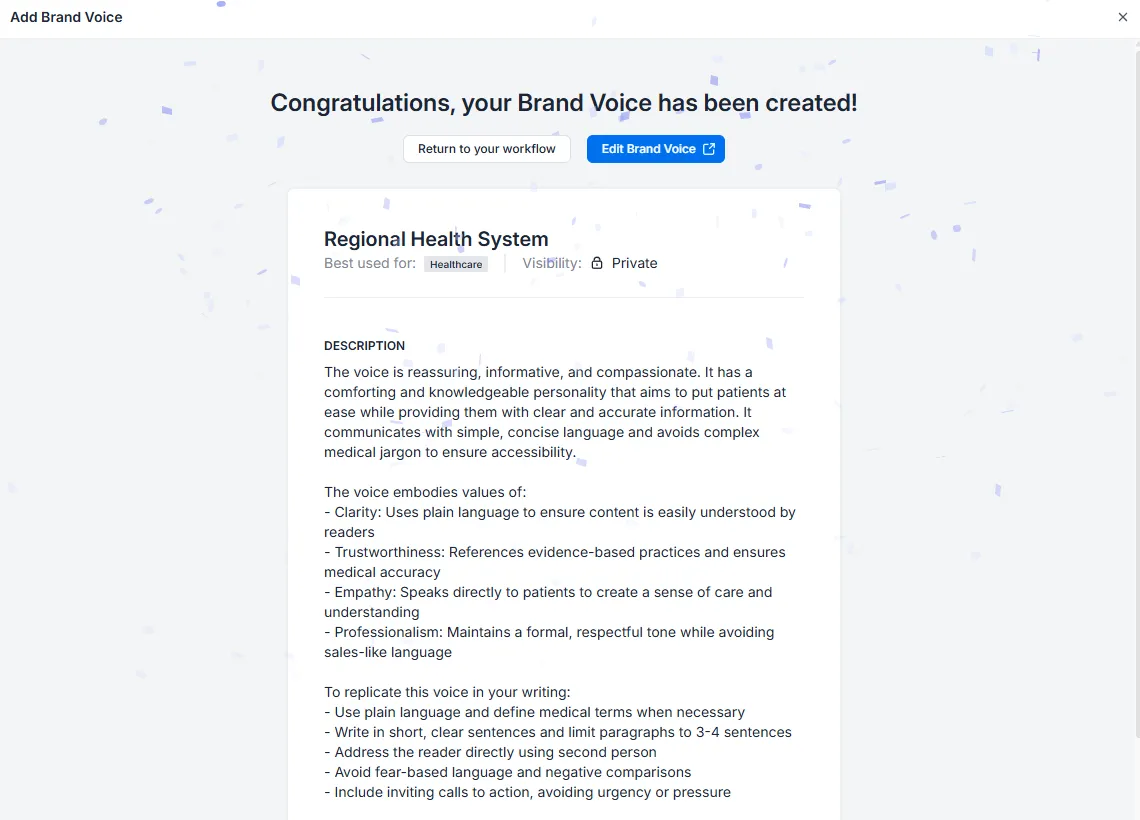
Jasper stood out for one reason above all others: brand voice control. In healthcare marketing, tone consistency isn’t a nice-to-have. It’s essential. A hospital system needs every piece of content, from service line pages to blog posts, to sound like it came from the same trusted source.
Jasper’s brand voice feature let us upload style guides, compliance terminology lists, and tone examples. The result was drafts that consistently matched our test organization’s voice and avoided the kind of aggressive health claims that make compliance teams nervous.
What we liked:
- Brand voice training produced the most consistent output across all five test tasks
- The “Knowledge” feature lets you upload approved medical language and source documents that Jasper references during generation
- Campaign-level workflows keep multi-asset projects organized, useful for service line launches
- Output rarely included absolute medical claims (“cures,” “guarantees”) that would need to be removed
- Team collaboration features let clinical reviewers comment directly in the editor
Where it fell short:
- Pricing starts at $49/mo (Creator plan), and the brand voice features require the Pro plan at $69/mo
- Medical accuracy was good but not perfect. We found 2-3 minor factual issues across our test set that required correction
- The learning curve for setting up brand voice properly is steeper than other tools
- No built-in HIPAA compliance checking (no AI tool has this, to be fair)
Best for: Hospital marketing teams, health systems, and healthcare agencies that need brand consistency across high volumes of content and have clinical reviewers in the workflow.
Transparency note (March 2026): Jasper AI has ended its affiliate program. We no longer earn commissions from Jasper referrals. This review is based on our hands-on testing and remains here because the tool evaluation is genuine and useful regardless of affiliate status.
Visit Jasper AI for a deeper look at pricing and features.
2. Frase.io: Best for SEO-Optimized Health Content
If your healthcare content strategy is built around organic search (and it should be), Frase is the tool to pair with your clinical writers. Frase doesn’t just generate content. It reverse-engineers what’s already ranking for your target keyword and helps you build something better.
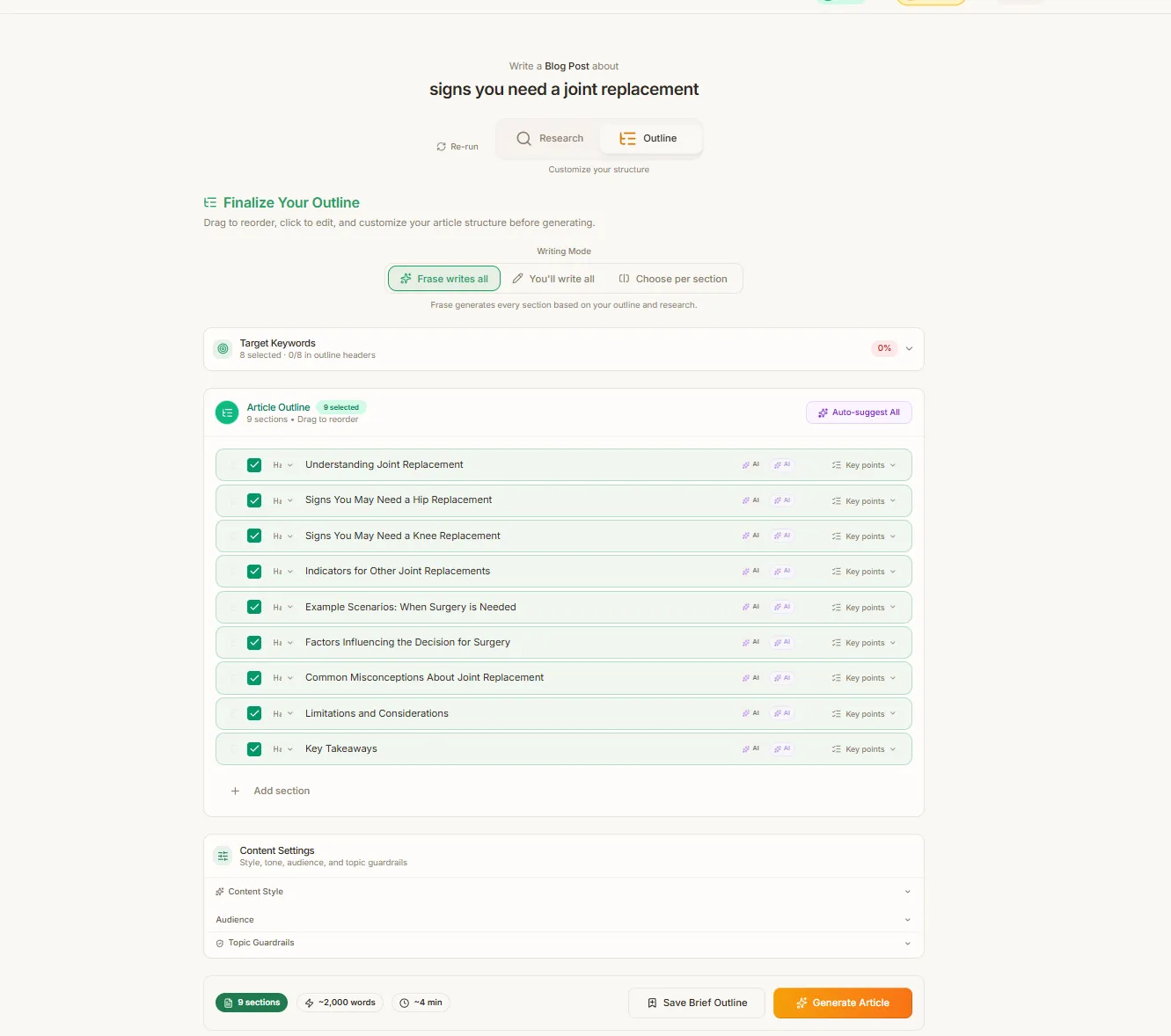
For healthcare SEO, this is particularly valuable. When we targeted “best telemedicine platforms for rural patients,” Frase pulled in the top 20 SERP results, identified the topics and questions they covered, and generated a content brief that our test writer could follow. The AI-generated draft covered 85% of the topical gaps we identified manually.
What we liked:
- SERP analysis is best-in-class. You see exactly what competing healthcare content covers
- Content briefs include “People Also Ask” questions, which are gold for patient education content
- The AI writer produced well-structured drafts with proper heading hierarchy
- Built-in optimization scoring tells you how comprehensive your content is versus competitors
- New GEO score and AI Visibility tracking show whether ChatGPT, Perplexity, Claude, and Gemini cite your content when patients ask AI tools health questions
- Pricing starts at $49/mo Starter (or $39.20/mo annual), positioning Frase as the AI search optimization specialist rather than a budget pick
Where it fell short:
- Less brand voice control than Jasper. Output sounds more generic
- Medical accuracy was comparable to Jasper (a few minor issues per piece) but the research-first approach sometimes surfaced outdated health information from older ranking pages
- No team collaboration features on lower-tier plans
- The AI writing quality is a step below Jasper for polished, patient-facing copy
Best for: Healthcare SEO specialists and content strategists who need to produce research-driven articles targeting specific medical and health keywords.
Read our full Frase.io review for pricing details and workflow walkthrough.
3. Copy.ai: Best for Patient-Facing Copy and Workflows
Copy.ai surprised us on the healthcare content test. Its workflow automation features (where you can chain prompts together into repeatable processes) turned out to be ideal for patient communication content like email sequences, appointment reminders, and FAQ pages.
The patient education blog post it generated was the most readable of the four tools we tested. Flesch-Kincaid score came in at grade 6.8, which is right in the sweet spot for patient-facing content. It also had the warmest, most empathetic tone, something that matters when your audience is worried about their health.
Note: Screenshots of Copy.ai’s healthcare workflow are unavailable following the discontinuation of our Copy.ai account.
What we liked:
- Workflow automations let you build repeatable templates for common healthcare content types
- Best readability scores across all test tasks. Naturally writes at a patient-friendly level
- Plans start at $29/mo (the free tier has been discontinued)
- Chat-based interface feels intuitive, even for non-technical marketing staff
- Strong at short-form content: email subject lines, ad copy, social media posts
Where it fell short:
- Weakest at long-form SEO content. Articles lacked the depth and structure of Frase output
- No content optimization or SERP analysis features
- Brand voice controls exist but are less sophisticated than Jasper’s
- Generated one factually incorrect claim about a medication interaction in our diabetes blog test, a reminder that clinical review is always required
Best for: Healthcare marketers focused on patient engagement, email marketing, and short-form content who need a tool their whole team can use without training.
Transparency note (March 2026): Copy.ai has ended its affiliate program. We no longer earn commissions from Copy.ai referrals. This review is based on our hands-on testing and remains here because the tool evaluation is genuine and useful regardless of affiliate status.
Visit Copy.ai for a breakdown of the free vs. paid tiers.
4. Writesonic: Best for Volume on a Budget
Writesonic is the pick when you need to produce a lot of healthcare content without a lot of budget. It’s not the most accurate, not the most polished, and not the most compliant-aware. But at $13/mo for unlimited words, it lets lean healthcare marketing teams draft content at a pace that would be impossible otherwise.
What we liked:
- Unlimited word count on paid plans means no throttling during big content pushes
- Article Writer 6.0 generates structured long-form content with real-time web research
- Built-in paraphrasing and readability tools help refine drafts
- Affordable enough for small clinics, private practices, and health startups
Where it fell short:
- Highest error rate in our medical accuracy test (4-5 factual issues across our test set)
- More aggressive marketing language in output (superlatives, unsubstantiated claims) that needed editing
- Brand voice controls are minimal compared to Jasper
- SEO optimization features exist but are less useful than Frase’s SERP analysis
Best for: Small healthcare practices and health tech startups that need content volume and have a clinician or compliance reviewer in the editing process.
Visit Writesonic for a pricing comparison.
Comparison Table
| Feature | Jasper AI | Frase.io | Copy.ai | Writesonic |
|---|---|---|---|---|
| Starting Price | $49/mo | $49/mo Starter | $29/mo | $13/mo |
| Medical Accuracy (our test) | Good (2-3 minor issues) | Good (2-3 minor issues) | Fair (3-4 issues) | Fair (4-5 issues) |
| Brand Voice Control | Excellent | Basic | Good | Basic |
| SEO Optimization | Good | Excellent | Limited | Good |
| Readability Score | Grade 8.2 avg | Grade 7.5 avg | Grade 6.8 avg | Grade 8.5 avg |
| Team Collaboration | Yes (Pro plan) | Limited | Yes | Limited |
| Workflow Automation | Yes | No | Yes (strong) | Limited |
| Best For | Brand consistency | SEO content | Patient comms | Volume drafting |
We compared output quality across all four tools using the same healthcare content prompts. See individual tool sections above for screenshots.
Tips for Using AI Writing Tools in Healthcare Content
These apply regardless of which tool you choose.
1. Always have a subject matter expert review every piece. This is not optional. AI tools hallucinate. They present made-up statistics with complete confidence. In healthcare, a hallucinated stat isn’t just embarrassing. It’s potentially harmful. Build clinical review into your workflow, not as an afterthought but as a required gate before publication.
2. Never let AI make medical claims. If the output says a treatment “cures” or “prevents” a condition, edit it out. Use language like “may help,” “research suggests,” or “talk to your doctor about.” Better yet, configure your prompts to explicitly instruct the AI to avoid absolute medical claims.
3. Cite sources for every factual claim. AI-generated content doesn’t come with citations. You need to add them. Link to peer-reviewed studies, FDA resources, CDC guidance, or your organization’s own clinical experts. This builds E-E-A-T and protects you legally.
4. Run content through readability checkers. Patient-facing content should target a 6th-8th grade reading level. Tools like Hemingway Editor (free) can catch complex sentences the AI generated that will lose your audience.
5. Keep a compliance checklist. Build a simple checklist that every piece of AI-generated healthcare content must pass before publishing: no unapproved claims, no patient identifiers, no off-label promotion, proper disclaimers included. Share it with your whole team.
6. Use AI for first drafts, not final drafts. The biggest mistake healthcare marketers make with AI tools is treating the output as finished. It’s not. Think of AI as a research assistant that gives you a solid starting point. Your clinical expertise and editorial judgment turn it into something you can publish with confidence.
Our Recommendation
For most healthcare marketing teams, Jasper AI is the right starting point. The brand voice controls and knowledge base features give you the guardrails that healthcare content demands, and the collaboration tools make it easy to loop in clinical reviewers.
If your primary goal is organic search and AI search visibility (Google plus ChatGPT, Perplexity, Claude, and Gemini citations), Frase.io at $49/mo Starter is the AI search optimization specialist. Its GEO score and AI Visibility tracking are the only major content-tool features built explicitly for the new AI answer engine landscape. Pair it with a clinical reviewer and you have a content engine that competes with much larger organizations.
Copy.ai is the pick for patient engagement teams that need warm, readable copy for emails, FAQs, and patient portals. And Writesonic works for budget-constrained teams that understand the tradeoff: you’ll save money but spend more time editing.
No matter which tool you choose, remember: in healthcare content, AI is the accelerator, not the driver. Your clinical expertise, compliance knowledge, and editorial judgment are what make the content safe to publish. The AI just helps you get there faster.
Frequently Asked Questions
What are the best AEO tools for healthcare content marketing?
What is the best AI for content creation in healthcare?
Are there AI healthcare marketing tools that understand HIPAA compliance?
How big is the AI medical writing market, and which tools lead it?
Which AI platform is best for medical content authoring?
Can AI tools produce accurate, publish-ready healthcare content?
Ready to Choose?
This article contains affiliate links. See our affiliate disclosure for details.