Our Top Picks
Frase.io
AI search optimization with GEO scoring, content briefs, and AI Visibility tracking
Starting at $49/mo · Best for: SEO professionals, Content agencies
Try Frase FreeKoala AI
One-click SEO-optimized blog posts and product reviews
Starting at $9/mo · Best for: Bloggers, Affiliate marketers
Try Koala AI FreeRytr
Budget-friendly AI writing assistant in 35+ languages
Starting at $8/mo · Best for: Freelance writers, Small businesses
Try Rytr FreeJasper AI
Enterprise-grade AI writing assistant for marketing teams
Starting at $49/mo · Best for: Marketing teams, Agencies
Visit Jasper AIIf you run a medical practice (a dental office, dermatology clinic, orthopedic group, or family medicine practice), you’re competing for patients online whether you like it or not. Patients Google their symptoms, compare providers, and read reviews before they ever call your front desk. The practices that show up in search results with helpful, accurate content win those calls.
The problem: creating that content takes time you don’t have. Writing a service page for each procedure, keeping a blog updated with patient education articles, posting to Google Business Profile weekly, and sending patient newsletters: that’s a full-time marketing job for a practice that might not even have a dedicated marketing person.
AI writing tools can fill that gap. But for medical content, the stakes are different than writing about sneakers or software. Medical inaccuracy isn’t just embarrassing. It’s potentially harmful and a liability risk. You need tools that produce content accurate enough for a clinician to review quickly, not rewrite entirely.
We tested four AI writing tools on real medical practice content (service pages, patient education blogs, Google Business posts, and patient communication emails) to find which ones work for practices operating without a dedicated marketing team.
What Is the Best AI Content Tool for Medical Practices?
Frase.io ($49/mo Starter) is the best overall AI content tool for medical practices that rely on organic search for new patients. Its SERP analysis, People Also Ask extraction, and new GEO score for AI search visibility help you build patient education content around the exact questions people Google (and ask ChatGPT, Perplexity, and Claude) before booking. For practices with truly tight budgets, the new pick is Outranking ($19/mo) paired with Koala AI ($9/mo). For a head-to-head between the two top SEO picks, see our Frase vs Surfer SEO comparison.
How We Tested
We created content for three practice types to cover different specialties:
- Bright Smile Dental: general dentistry with cosmetic services (Austin, TX)
- Summit Orthopedic Associates: sports medicine and joint replacement (Denver, CO)
- Lakewood Family Medicine: primary care with wellness programs (Lakewood, OH)
For each practice, we generated:
- Service page (e.g., “Dental Implants in Austin, TX” or “ACL Reconstruction Recovery”)
- Patient education blog post (e.g., “What to Expect After Knee Replacement Surgery”)
- Google Business Profile post promoting a seasonal service
- Patient email: appointment follow-up with care instructions
We evaluated: medical accuracy, readability (targeting Flesch-Kincaid grade 6-8 for patient-facing content), local SEO keyword placement, and how much editing a practice owner or office manager would need to do before publishing.
Our Top Picks
- Frase.io: Best for SEO and AI search optimization at $49/mo Starter
- Koala AI: Best value for practices on a tight budget at $9/mo
- Rytr: Best free option for getting started
- Jasper AI: Best for multi-location practices with brand standards
1. Frase.io: Best for Patient Education Content That Ranks
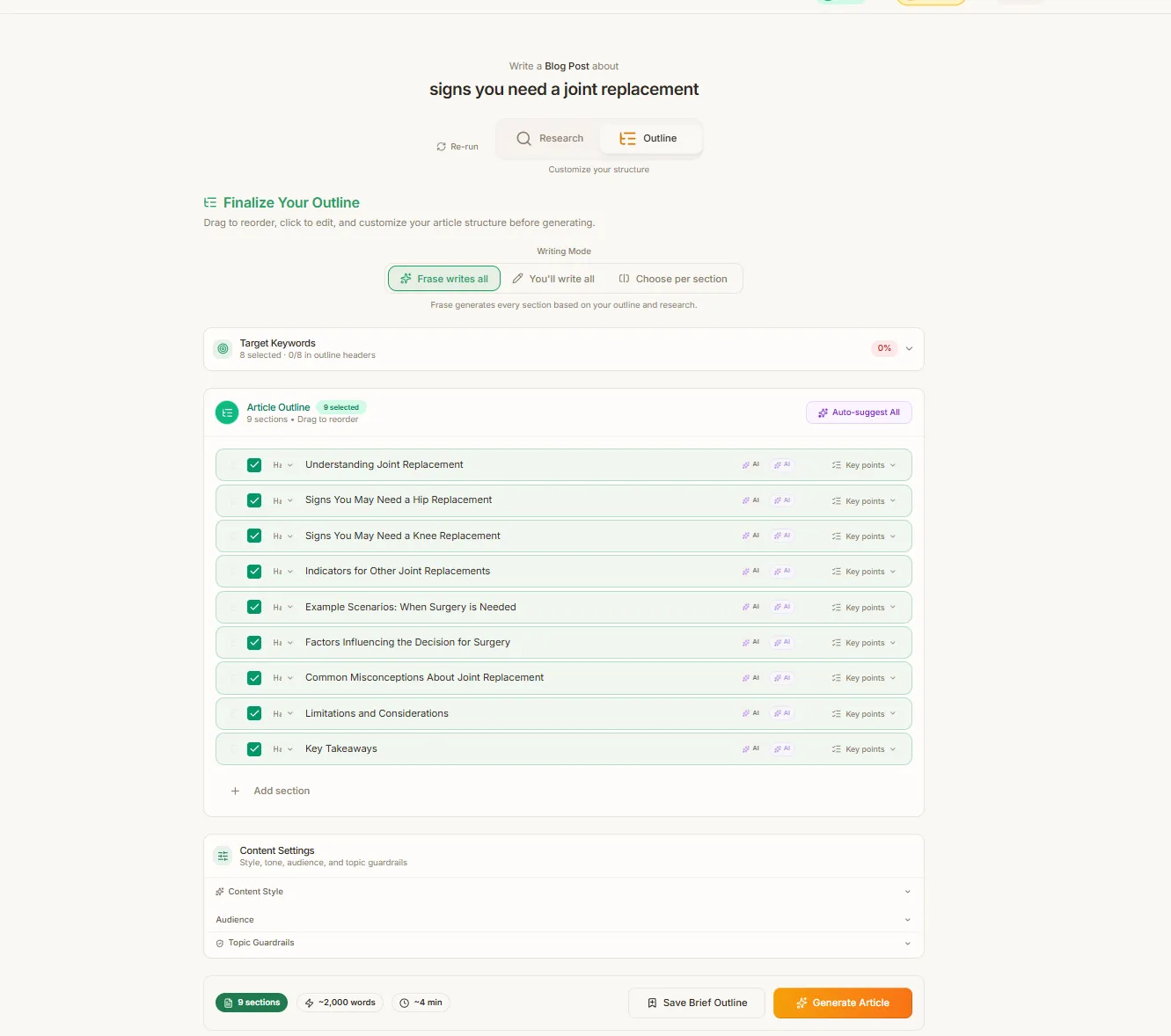
If your practice’s growth strategy depends on patients finding you through Google (searching “best dentist near me” or “what causes knee pain when climbing stairs”), Frase is the tool that directly supports that strategy. It doesn’t just write content; it reverse-engineers what’s already ranking for your target keywords and helps you create something better.
For the dental practice test, we targeted “dental implants cost Austin TX.” Frase analyzed the top 20 results, identified the topics and questions they covered (procedure steps, recovery time, insurance coverage, financing options), and generated a content brief our test writer could follow. The AI-generated draft covered 80% of the topical gaps without manual research.
What we liked:
- SERP analysis shows exactly what competing practice websites cover, so you see the gaps in their content
- “People Also Ask” integration surfaces the questions patients actually search for (gold for FAQ sections and blog topics)
- Content scoring tells you how comprehensive your page is versus competitors
- New GEO score and AI Visibility tracking help you see whether ChatGPT, Perplexity, Claude, and Gemini cite your content when patients ask AI tools health questions
- The research-first approach means content is structured around what Google rewards, not guesswork
- $49/mo Starter (or $39.20/mo annual) now positions Frase as the upgraded pick for serious content operations rather than the cheapest option
Where it fell short:
- The AI writing itself is good but not great. It sometimes produces generic health content that could apply to any practice anywhere
- No built-in tools for Google Business Profile posts or short-form content
- Medical accuracy was comparable to competitors (2-3 minor issues per piece that a clinician would catch)
- Team features are limited on the basic plan
Best for: Practices that want to rank for procedure-specific and location-specific keywords. If “dentist in [your city]” or “[procedure] near me” searches are your patient acquisition channel, Frase builds the content strategy around what Google actually ranks.
Read our full Frase.io review for pricing details and a walkthrough of the brief generation workflow.
2. Koala AI: Best Value for Budget-Conscious Practices
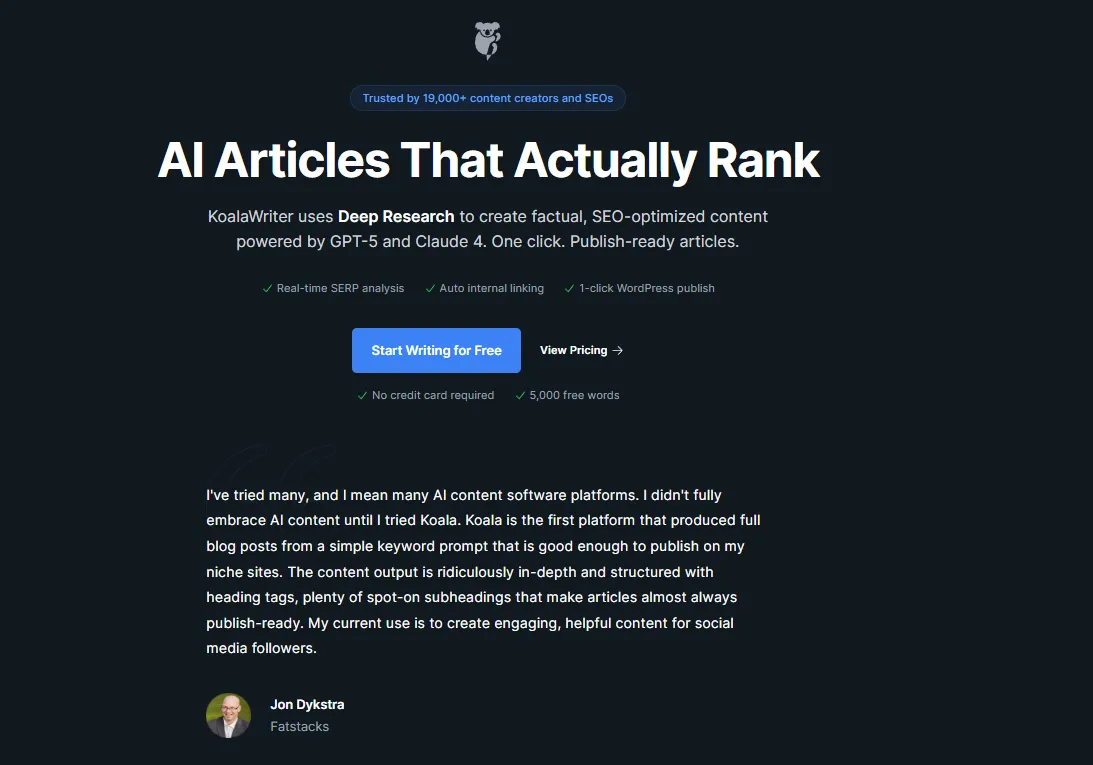
At $9/mo, Koala AI produces the best patient-facing content per dollar of any tool we tested. The one-click article generation is particularly useful for practices. Enter a topic like “What to Expect During a Root Canal” and Koala generates a complete, structured blog post with headings, patient-friendly language, and a natural conclusion. Most posts needed only a clinical accuracy check and minor local customization before publishing.
What we liked:
- One-click blog articles save the most time of any tool tested. Enter a keyword, get a complete post
- Built-in SEO optimization adds keyword targeting without manual effort
- Output readability scored well for patient audiences (grade 7-8 Flesch-Kincaid without adjustment)
- $9/mo makes it accessible for practices of any size
- Product description mode works well for procedure/service pages too
Where it fell short:
- No real-time SERP analysis like Frase. You’re trusting the AI, not data, to cover the right topics
- Service page output was decent but less structured for local SEO than Frase’s research-driven approach
- No short-form templates for GBP posts or patient emails
- Occasional generic phrasing that could describe any practice (needs local details added manually)
Best for: Solo practitioners and small practices that need blog content and service pages at the lowest cost possible. If you’re publishing 2-4 blog posts per month and updating service pages quarterly, Koala covers it for $9/mo.
Read our full Koala AI review for a deep dive on features and output quality.
3. Rytr: Best Free Option to Start
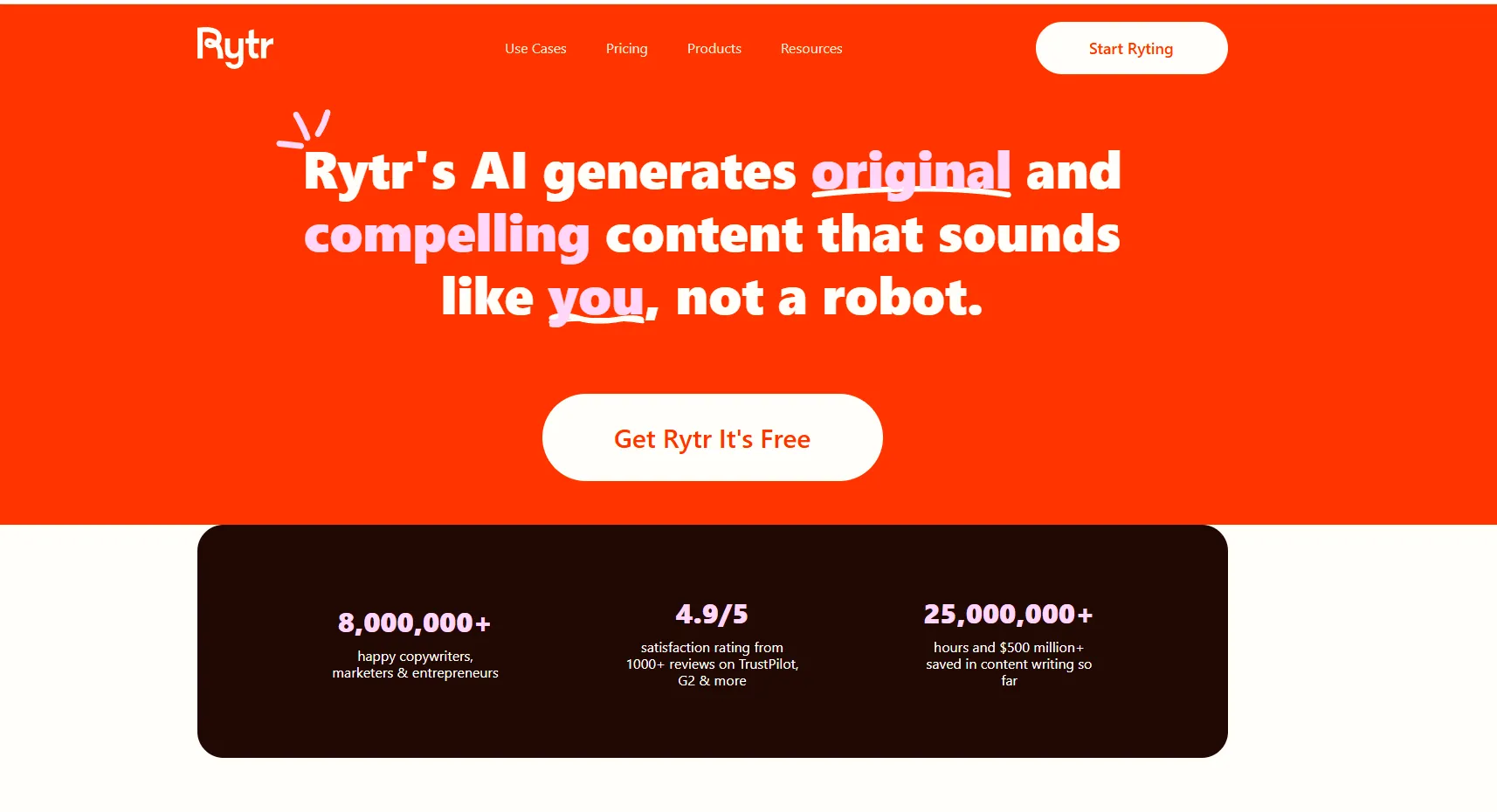
If your practice has never used AI writing tools and you want to test the concept before spending anything, Rytr’s free tier is the starting point. You get 10,000 characters per month (roughly 2-3 blog posts or 5-6 short pieces), access to all 40+ content templates, and 20+ tone presets, no credit card required.
For medical practices specifically, Rytr’s strength is short-form content: patient appointment reminders, Google Business posts, social media captions, and email subject lines. The 20+ tone presets let you quickly switch between professional (for clinical content) and warm/friendly (for patient communication) without rewriting prompts.
What we liked:
- Genuinely free, no trial, no credit card, no expiration
- Tone presets are ideal for switching between clinical and patient-friendly voice
- Short-form templates (email, social, GBP posts) cover the quick content needs practices have
- Simple interface that non-technical office staff can use immediately
- Paid plans start at just $7.50/mo if you outgrow the free tier
Where it fell short:
- 10K character free limit runs out fast (about 2-3 blog posts per month)
- No article generator. Blog posts require generating sections individually and assembling them
- Zero SEO features (no keyword targeting, no content scoring)
- Output quality is serviceable but formulaic compared to Koala or Frase
- Medical content occasionally used phrasing that was too casual for a clinical context
Best for: Practices testing AI content for the first time, or practices that mainly need short-form content (GBP posts, emails, social media) and don’t have budget for paid tools yet.
Read our full Rytr review for a detailed look at the free tier and pricing.
4. Jasper AI: Best for Multi-Location Practices
Jasper is the premium option on this list at $49/mo, and for a single-location practice, it’s likely overkill. But if you manage marketing for a multi-location medical group (a dental chain with 5 offices, a physical therapy network across a metro area, or a health system with multiple specialty clinics), Jasper’s brand voice and campaign features justify the price.
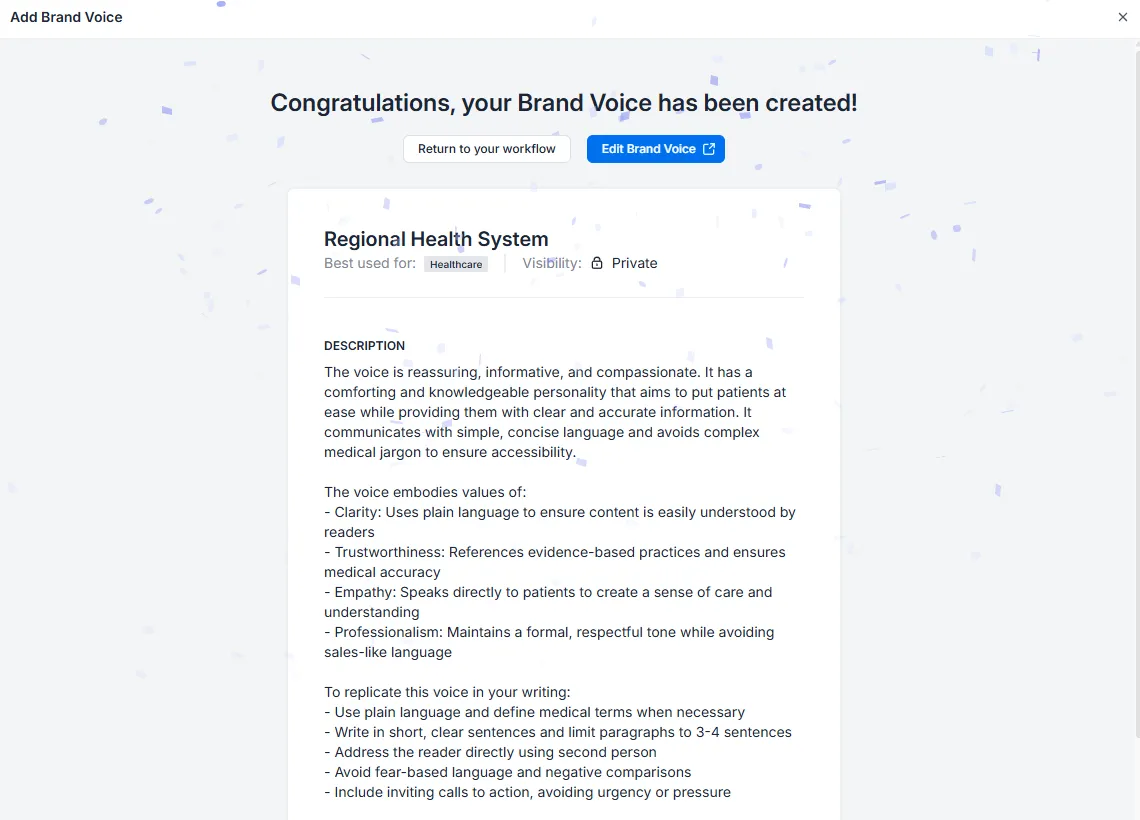
The brand voice feature was the standout. We uploaded a style guide with approved medical terminology, tone guidelines (warm but professional, never condescending), and compliance notes (no absolute health claims, always recommend consulting a provider). Jasper maintained that voice across service pages, blog posts, and emails for all three test practices without drift.
What we liked:
- Brand voice training ensures every location sounds consistent, which is critical for multi-practice groups
- Campaign feature generates unique service pages per location without duplicate content
- Team collaboration lets clinical reviewers comment directly in the editor
- Output rarely included absolute medical claims that would need compliance removal
- Chrome extension for writing directly in your EHR portal or website CMS
Where it fell short:
- $49/mo is steep for a solo practice. Koala at $9/mo covers most needs
- Medical accuracy was good but not perfect. Still requires clinical review
- Brand voice setup takes time upfront (1-2 hours to configure properly)
- No SEO research features like Frase. It writes well but doesn’t analyze what Google wants
Transparency note (March 2026): Jasper AI has ended its affiliate program. We don’t earn commissions from Jasper. We include it because it genuinely outperforms other tools for multi-location medical groups in our testing.
Best for: Multi-location practices and medical groups that need brand consistency across all locations and have budget for a premium tool.
Quick Comparison
| Feature | Frase.io | Koala AI | Rytr | Jasper AI |
|---|---|---|---|---|
| Starting price | $49/mo Starter | $9/mo | Free | $49/mo |
| Blog articles | Good (research-driven) | Very good (one-click) | Sections only | Good |
| Service pages | Excellent (SEO-optimized) | Good | Basic | Very good |
| GBP posts | No | No | Good | Decent |
| Patient emails | No | No | Good | Good |
| SEO research | Excellent | Basic | None | None |
| Medical accuracy | Good (2-3 issues/piece) | Good (2-3 issues/piece) | Fair (3-4 issues/piece) | Good (2-3 issues/piece) |
| Brand voice | Basic | Basic | 20+ presets | Advanced |
| Best for | SEO content strategy | Budget blog content | Free starting point | Multi-location groups |
The Non-Negotiable: Clinical Review
No AI writing tool produces publish-ready medical content. Not one. Every piece of content that mentions symptoms, treatments, medications, procedures, or health advice must be reviewed by a qualified clinician before it goes live. Here’s what to watch for:
Accuracy checks: AI tools occasionally state outdated treatment protocols, mix up drug interactions, or present risk factors with incorrect probability language. A 30-second review by a nurse or physician catches these. Publishing without review creates liability.
Compliance language: Avoid absolute claims (“this treatment will cure…”), unapproved indications, and any language that could be interpreted as a diagnosis. AI tools default to confident, marketing-style phrasing that sometimes crosses these lines.
Local customization: AI-generated content is generic by default. Add your practice’s specific details: your providers’ names and credentials, your office locations, your accepted insurance plans, your specific approach to patient care. This is what makes content unique and builds trust.
HIPAA reminder: Never input patient data into any AI tool. No real patient names, no case details, no PHI. Write about conditions and procedures in general terms. This seems obvious, but the conversational nature of AI tools makes it easy to slip.
How to Choose
Your budget is $0: Start with Rytr free tier. Generate GBP posts, patient emails, and test blog content. Graduate to Koala AI when you’re ready to invest.
Your budget is $9-28/mo (tight budget): This is where most single-location practices on a tight budget should land. Choose Koala AI ($9/mo) if you mainly need blog posts and service pages. Add Outranking ($19/mo) for SERP analysis, content briefs, and automatic internal linking ($28/mo combined).
Your budget is $49+/mo: Choose Frase.io ($49/mo Starter) if SEO rankings and AI search visibility are your primary patient acquisition strategy. Multi-location practices should pair Jasper AI ($49/mo) for brand voice consistency with Frase for the SEO and AI search layer.
The combo we’d recommend for tight-budget practices: Koala AI for writing ($9/mo) + Outranking for SEO research and internal linking ($19/mo) = $28/mo for a content engine that would cost $800-1,500/mo from a healthcare marketing agency. Add Rytr free tier for quick social and email copy. Practices with $49+/mo budget should swap Outranking for Frase.io to gain AI search optimization (GEO score, AI Visibility tracking).
For a broader look at AI writing tools across healthcare marketing (including hospital systems and health tech), see our companion article: Best AI Content Tools for Healthcare Marketers.
Pricing verified as of March 2026. All AI-generated medical content must be reviewed by a qualified healthcare professional before publication. We test and update this article monthly.
Frequently Asked Questions
What are the best AI content tools for medical practices?
Can AI write medical practice website content?
Which AI tools understand healthcare content?
Is AI-generated medical content HIPAA compliant?
How much do AI tools for medical practices cost?
Can AI write patient education materials?
Ready to Choose?
This article contains affiliate links. See our affiliate disclosure for details.